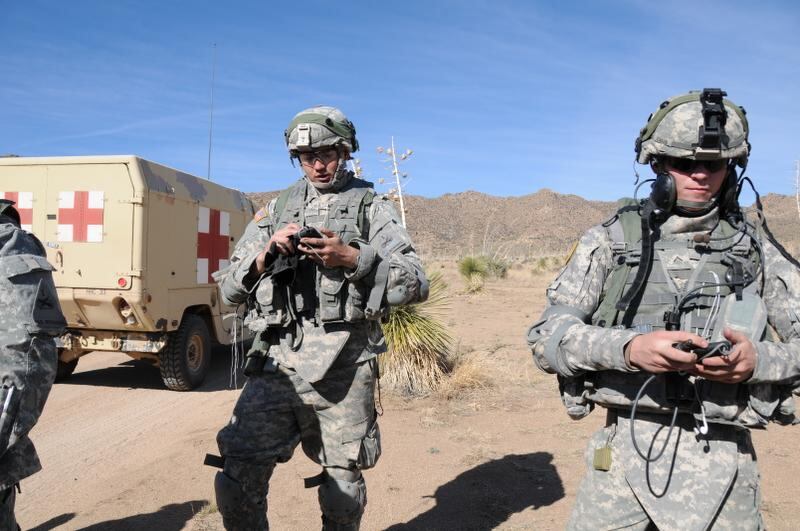
Army-branded mobile applications aren't a new development: Soldiers already can learn how to call in a medevac, get a refresher on social media policy, even study the ins and outs of operating the Patriot missile system, all via app.
But new apps are geared less toward teaching and more toward in-theater results. And thanks to off-the-shelf software development tools, they could be arriving at a faster clip than most new Army gear.
Here are five things you need to know about the service's ever-expanding app store:
1. Meet ODIN. Your smartphone easily sniffs out available wireless networks in any operational environment — a coffee shop, for instance. The On Demand Information Network, or ODIN, will let soldiers find and link to networks in much the same way, solving in seconds a communication problem that could cost units valuable time tweaking their gear to speak with other nearby forces.
"Previously, companies with different radio networks could not talk to each other, and it could take several days or a week to reconfigure that," said Dan Stroka, who leads the Mounted Android Computing Environment project for the Army's Program Executive Office for Command, Control and Communications-Tactical. The ODIN app, now in the testing phase, lets soldiers identify and connect to interoperable networks with the push of a button.
2. Speed of tech. ODIN's initial build-out took three months, Stroka said, thanks to the use of the commercially available developer tools. Without them, he said, the app could've taken a year.
This strategy could shave time off of any future app efforts and allow the Army to keep close pace with private-sector technology improvements.
3. No-radio fires control. Not up for ODIN? The Army's Brigade Modernization Command-Mission Command Complex at Fort Bliss, Texas, is working on an app that will allow a forward observer interface with the tactical fires direction capability of artillery.
The observer could use the app to direct lethal or nonlethal fires, even without access to traditional radio communications.
4. Mobile medic. Developers have zeroed in on medical apps as a growth area, as they can provide combat medics with a wealth of information in seconds — when time really matters.
"We can give him the ability to access physicians' or desk references," said Michael McCarthy, director of operations/program manager for the modernization command. "There are lots of things that they can access that a medic previously did not have, which helps them make a better diagnosis."
Apps also can put the medic in real-time communication with a physician, with cameras possibly giving medical experts a live look at the injury.
5. Keep it simple (and safe). Future apps should err on the side of simplicity, development experts say, pointing to easy-to-use programs like Uber and game- or competition-based programs like Fitbit as models.
Developers also must adhere to strict processes that keep the new tools both safe and functional, McCarthy said — otherwise, "someone could put something out there that unintentionally puts people at risk."
Adam Stone and Kevin Lilley contributed to this report