For starters, Dr. Thomas Easterly, known as the Army’s “AI Guy,” has recommended that soldiers transitioning out of the military and looking for a job might want to try turning artificial intelligence loose on the information in their DD-214s.
Think of it as “using AI to navigate your next mission,” Easterly said in a June 29 podcast of the Army’s Transition Assistance Program. Troops can feed information from the DD-214, the record of military service, into AI — minus the Social Security number and other identifiers — and give it prompts to decipher what jobs might be suitable, how much those jobs pay and what the chances might be for getting hired, he added.
In the process, transitioning soldiers should ditch the mindset that AI is a job-killing obstacle to overcome and instead think of it as a tool “that can support your transition,” said Easterly, director of the Plans, Analysis and Integration Office at Carlisle Barracks, Pennsylvania.
About 200,000 service members — 100,000 from the Army alone — leave the military each year, and this year they are entering a jobs market in flux, with the long-term effects of AI anybody’s guess. According to the Bureau of Labor Statistics, only 57,000 jobs were created in June, about half of what Wall Street analysts had expected in the current low-hire, low fire jobs market.
The impact of AI, which some have compared to the vast societal changes brought about by the Industrial Revolution, hasn’t yet produced the job apocalypse feared by many, but in May U.S employers cut 97,006 jobs, an increase of 16% over the 83,387 jobs cut in April, according to a report from the global outplacement firm Challenger, Gray & Christmas.
The report showed that “AI is now the leading reason companies give for cutting jobs and the primary industry citing it is technology,” Andy Challenger, chief revenue officer for the Challenger firm, said in the report. “The open question isn’t whether AI changes the workforce, but how fast.”
The AI issue will become all too real in a few days for Navy Lt. Cmdr. Alvin Carr, 34, a U.S. Naval Academy graduate, when he leaves the military at the end of July after 13 years in the sea service, mostly in human resources.
“I think I definitely saw that AI was a tool that was being widely adopted” by employers in their recruiting and screening efforts, Carr said in a phone interview with Military Times, but “I don’t think I had the awareness of the impact of AI on the job market that I have now.”
“I heard it’s going to be a tough,” Carr added, noting that he was still confident that “I shouldn’t have to struggle too much,” given his degree from Annapolis and the masters in business administration he earned during his time in service.
Carr is one of the transitioning service members who has sought the help of career “coaches” at the Wounded Warrior Project, where Lesly Marmolejos is a career transition manager for WWP’s Warriors to Work program.
Her first task in meeting with newcomers to the program is to disabuse them of what they think they already know about AI.
“If you tell me you’re an expert in AI, I know you’re lying,” Marmolejos said in a phone interview with Military Times.
As a “coach,” Marmolejos said one of the first things she tells transitioning troops is that there’s “not any type of certification you can get in AI. Well, there is, but it would be irrelevant in a month.”
Despite all the emphasis on being tech proficient, “I still very much believe that the human side of the hiring process is very important,” she said. “The feedback that I’m getting is that while we have to learn how to use AI as part of the employment process, we still matter. If you talk to a [jobs] recruiter, they’ll say the same thing.”
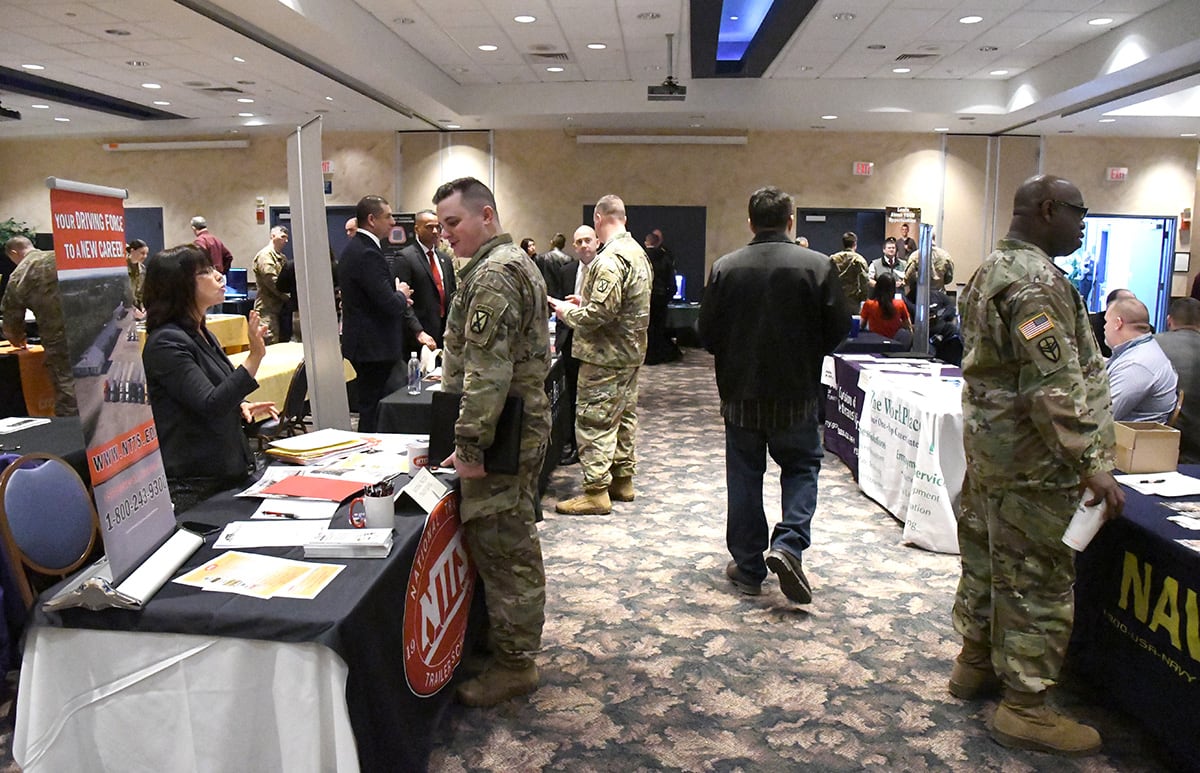
Networking is still a major component of the job search, Marmolejos added, and “we still encourage [service members] to go to job fairs. Who you know matters, and who can give you a referral still matters. I don’t think [AI is] the big bad wolf everyone’s making it out to be.”
In a separate phone interview with Military Times, Jacob Mousseau, a former Army sergeant and a coaching colleague of Marmolejos at WWP, said, “New people need to get over their fear” of AI and stop doomscrolling on how AI is going to make humans in the workforce obsolete.
Mousseau echoed Marmolejos in stressing the importance of networking, calling it “critical this year more than ever.”
He has developed his own five-step strategy for assisting transitioning service members in their job search, beginning with career exploration by using AI to turn “an assessment into a personalized roadmap — realistic pathways, salary ranges, target organizations, a 30-day plan to explore before committing.“
“I use it to build deep, individualized guides for warriors,” Mousseau added, “and I teach them to run a lighter version themselves so they can keep exploring on their own.”
Another perspective was offered by Ben Dufay, a veteran of both the Army and Navy who now is director of career preparation and training at the D’Aniello Institute for Veterans and Military Families at Syracuse University.
“We’re transitioning into an environment where even people in the environment don’t know what’s going on,” Dufay said of the impact of AI on employers as well as job seekers. “Everybody knows somebody who’s been laid off. Employers don’t know what they want out of AI. It is disrupting stuff. ... Transition has always been something of a guessing game. That hasn’t changed.”
AI’s impact has only added to the traditional list of questions transitioning service members have, he noted.
“I don’t know what AI is. How does it help me?” Dufay stated, citing common questions. “How can I use it to assist me? What’s going to get me into an interview? How do you continue to engage with it, leverage it?”
Transitioning service members will also be facing a jobs market where an employer will occasionally decide that going with AI for a certain task was the wrong move, as happened with the Ford Motor Co. last month.
In a June 29 press call, Charles Poon, Ford’s vice president of Vehicle Hardware Engineering, said that AI had botched the job of quality control.
Poon called for about 300-350 engineers to be hired to clean up the mess.
“Mistakenly, we thought that by just introducing artificial intelligence and ingesting the design requirements that we had, that that would produce a high-quality product,” Poon said.