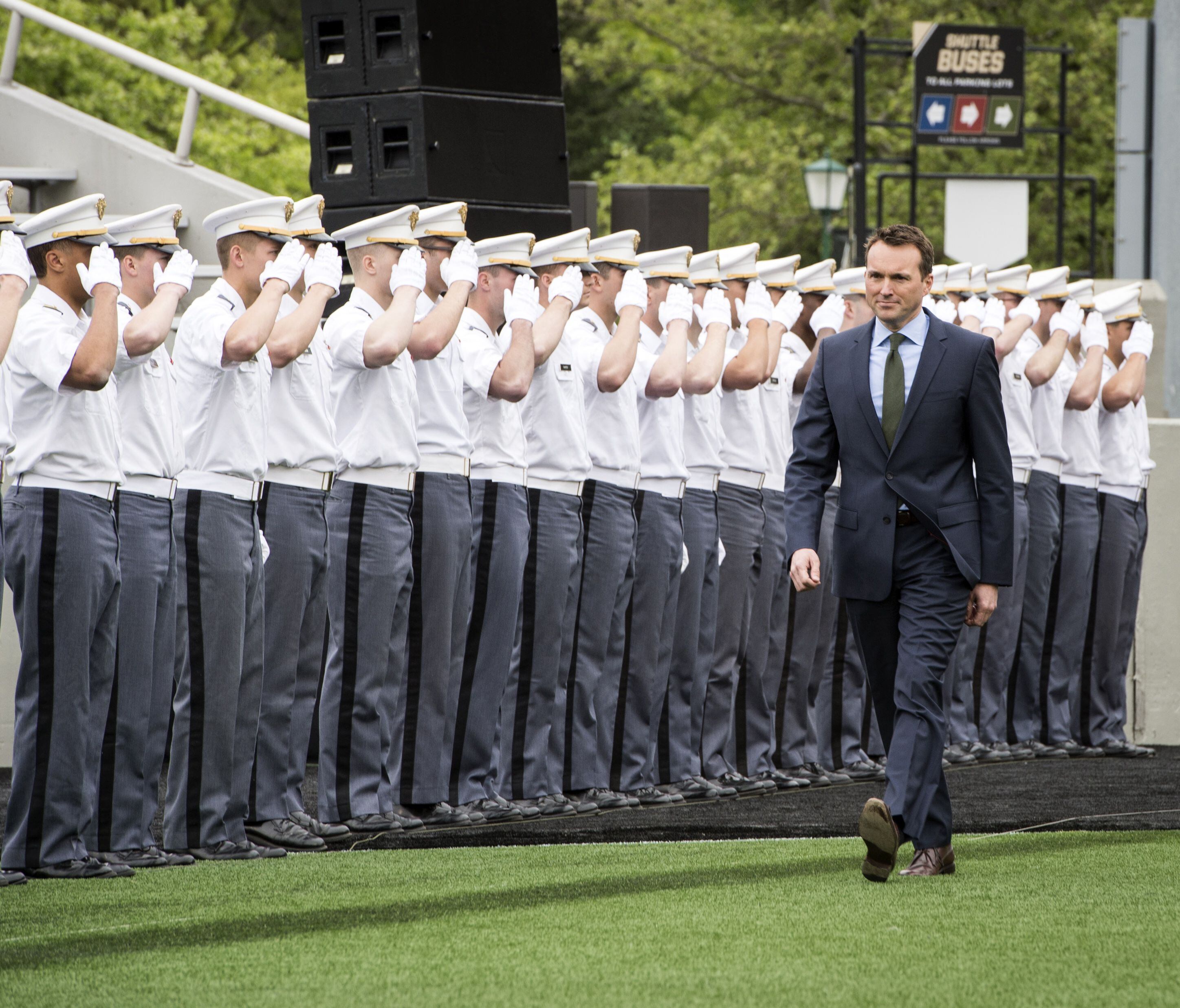

With less than two weeks on the job, Army Secretary Eric Fanning is already focused on providing soldiers and their families with more predictability amid increasing demands on the force and ongoing budget constraints.
Fanning, who was sworn in May 18 as the Army’s 22nd Army secretary after a bumpy eight-month confirmation process, is no stranger to the military or the Pentagon. In addition to key leadership positions in the Air Force and Navy, Fanning has served as the Army’s acting under secretary and later as the acting secretary and got a first-hand look at the Army and its soldiers.
"What I’ve seen is an Army, to me, that looks tired," Fanning said in an interview with Army Times. "We haven’t been investing in installations like we probably should have, and we’ve been deploying people non-stop for 15 years now. I worry about what we’re doing to the force in the long term and looking for ways to find some stability and predictability for them."
Among his chief concerns is the budget and the demand for soldiers around the world.
"The main challenge with the budget is the instability of it, the unpredictability of it," Fanning said. "We start every year with a continuing resolution and the threat of a government shutdown. We’ve got sequestration looming on the horizon."
Steady, predictable funding saves money over time, and it allows the Army to better train and equip soldiers, he said.
"Not having that stability makes it very hard to build a budget and build a long-term program," Fanning said. "That’s the biggest struggle I think we face."
During the wide-ranging interview with Army Times, Fanning also talked about his short-term goals, the challenges facing the Army, what it means to be the first openly gay service secretary, and his message to soldiers.
Here’s a closer look at what the Army’s new top civilian leader had to say.
His immediate goals.
"My first immediate goal is to get out of the Pentagon, get out in the field and interact with soldiers," Fanning said. "The things I want to focus on for whatever time I have in this appointment is, first, taking care of people."
That includes the "gamut of things," from combating sexual assault and suicide to taking care of families, he said.
"I want to look in particular into mental health treatment and making sure we have everything soldiers need in that area," Fanning said.
His second short-term goal is to focus on emerging threats.
"We’re learning a lot about how other countries are fighting based on what we’re seeing right now and where there might be some gaps," Fanning said. "I’m thinking specifically about cyber, electronic warfare and survivability. Those are three things I want to focus on in a new rapid capabilities office."
Fanning first publicly discussed standing up a rapid capabilities office during his confirmation hearing. The office would be similar to the one he initiated during his time with the Air Force, and it will help streamline the acquisition process, help keep costs under control, and help senior leaders make "wise decisions" at the appropriate times, Fanning said during the hearing.
His third immediate priority is acquisition reform, Fanning said.
It’s "not very sexy, and we’ve been reforming acquisition since the dawn of time," he said.
But Defense Secretary Ash Carter and the chairmen of the Senate and House armed services committees are all very focused on the issue, so "now’s the time to ride that and see if we can’t do things to make the process more agile and field capabilities faster and get soldiers the equipment they need faster than they do now," Fanning said.
The Army’s budget crunch.
"For me, the greatest threat facing the Army is the budget unpredictability and sequestration," Fanning said. "A lot of people think sequestration was ended with this budget deal, but it’s only for two years. If we don’t get another budget deal after this, and the environment gets more and more convoluted on the Hill, we’re going to have to drop down to sequestration, and the Army is going to be cut even more than it is now."
Fanning said he’s not only concerned about the Army getting even smaller, but its inability to build a long-term plan.
"It’s very expensive to budget year by year by year, rather than with a long-term plan," he said.
It also forces the Army to make difficult choices when it comes to modernization.
"In this budget environment … we look first to make sure that we’re taking care of soldiers today, that they’re properly trained and equipped for the fights we’re sending them into today," Fanning said. "What you push down the road a little bit sometimes are longer-term investments [such as] facilities, procurements. We are looking at that, trying to figure out that we’ve got the balance right, that we don’t have any one area where we’re underinvesting to the detriment of future soldiers."
The size of the force.
As the Army continues to draw down — including cutting the active Army from a wartime high of 570,000 soldiers down to about 450,000 by fiscal year 2018 — there has been plenty of discussion, including on Capitol Hill, about halting or slowing the cuts and how big the Army really needs to be.
If the cuts continue as planned, the Army — active, National Guard and Army Reserve — will number about 980,000 soldiers.
"I think we’ve built a force structure … that aligns with the resources we’re given by Congress in the Bipartisan Budget Agreement, and that number meets the requirements of the combatant commanders," Fanning said. "There are risks, and we look for ways to mitigate that with the resources we’re given. I think everybody would like their force to be larger, but we’ve built a force structure that’s sized against resources and against strategy."
If Congress decides to maintain a larger Army, the service will need the money that goes with it, Fanning said.
"If we are given increased force structure without the budget to pay for it, that’s going to hurt readiness," he said. "We’re going to have to pull more money out of training, more money out of procurement. One of the reasons that we built the budget that we did and have the force structure of 980,000 that we’re targeting is to have balanced forces that we can train and equip."
Demand for soldiers around the world.
As the Army continues to draw down, the demand for troops grows, with soldiers deployed to Iraq, Afghanistan, Europe, Africa, the Pacific and everywhere in between.
The demand for soldiers is not going away, Fanning said.
"There have always been demands on the Army, and there always will be," Fanning said. "The Army is a resilient institution with strong leaders that figure out how to make that work. My challenge is to do what I can to mitigate any negative effects, like taking care of families, making sure soldiers are resilient, that they’re trained and equipped."
One priority for him is to make sure the Army has as much combat power as possible, Fanning said.
"That’s something every secretary should do, and in my experience does do, and that’s constantly culling through to make sure you’re as efficient and effective as possible," he said. "That’s headquarters reductions, that’s finding different ways of doing business so that we can move as much of the force structure we’ve got to the tip of the spear."
Becoming the Army secretary.
The road to confirmation for Fanning was long and bumpy, especially for someone with his resume.
"I never lost hope that I would get confirmed," Fanning said. "I always expected it would happen at some point, but it’s a frustrating process, it’s a lengthy process. I hope something changes on it."
President Obama in September nominated Fanning to succeed then-Secretary John McHugh. At the time of his nomination, Fanning was the acting under secretary of the Army, a position he’d held since June.
Fanning was named the acting Army secretary after McHugh retired in November, but he stepped down from that position in January while he waited for his confirmation hearing.
He sailed through his Jan. 21 hearing in front of the Senate Armed Services Committee, but he then faced a hold from Sen. Pat Roberts, R-Kan., who wanted assurances from the Obama administration that Kansas would not be considered as a site for relocating prisoners if the detention center in Guantanamo Bay, Cuba, is closed.
Roberts relinquished the hold May 17 after announcing on the Senate floor that he had received the assurances he sought. Fanning confirmed the same day and sworn in May 18.
Even though he was in limbo for eight months, Fanning said he had it easy as he was already working in the Pentagon and didn’t have to move a family across the country for the job. But that didn’t make the wait any less frustrating, he said.
"When the [confirmation] hearing was over, I had time to sit back and think strategically about what I was going to do once I got confirmed, and then every week we would redo that plan, redo that schedule, because I wasn’t getting confirmed," he said. "So that got frustrating because I would get excited about what we wanted to do, but it kept getting pushed back. To just be hanging out there day after day after day was an enormously frustrating experience."
Being celebrated as the first openly gay service secretary.
"I’ve gotten used to it," Fanning said, when Army Times asked about the media attention he has received for his personal life. "Every time I get a new job, it becomes a story. At times it’s frustrating because you want them to focus on your qualifications."
But along with those news stories also comes a "tremendous outpouring of support," Fanning said.
"I realize that there is value in this for a lot of people who either didn’t have opportunities or don’t think they had opportunities, to see someone like me in a job like this, they see what opportunities might be available to them," he said. "In that sense, I embrace it."
But Fanning also just wants to get to work.
"I think what’s far more significant is I’m the only person who’s worked in all three [military departments] and can bring what I’ve learned in the Navy and the Air Force to the Army," he said.
Being a social media guru.
Fanning has already gained attention for channeling Beyonce and Taylor Swift while also deftly engaging with Duffel Blog, the popular military satire site, on his social media accounts.
"I think a very important part of this job is communicating," Fanning said. "We’re 40-plus years into an all-volunteer force, a very strong force, but there is a growing divide, in my mind, between those who serve and those who are being protected, and so I’m going to use every tool possible to communicate to the force but also to make sure I’m communicating to the country about its force."
He acknowledged that social media can often take a negative turn, adding that he saw some of the ugliness during his confirmation process.
"We have free speech, people can say what they want to say," Fanning said. "There is something about social media and the distance people feel or the protection people feel … that allows people to express stronger opinions than in other forums."
Fanning’s advice is to focus on the support that comes across on social media, and he called on critics to "try to be as constructive as you can. Everybody who meets the requirements should have the opportunity to serve."
As he settles into the job, Fanning hopes to use his social media accounts to reach soldiers.
"Really, what I want to do is get interactive with soldiers, and that’s a medium where I can hear back from them," he said.
His message to soldiers.
"What I would say to soldiers is that we ask them to do incredible things, and my job as secretary of the Army is to make sure that they are fully trained and properly equipped to do the mission and get home safely," Fanning said, "and while they’re deployed, to take care of their families."
Michelle Tan is the editor of Army Times and Air Force Times. She has covered the military for Military Times since 2005, and has embedded with U.S. troops in Iraq, Afghanistan, Kuwait, Haiti, Gabon and the Horn of Africa.