Heroism takes many forms in war. It may emerge amid an epic battle, or the drama may focus on a single life struggling to keep alive in a shell hole. In any case, there are choices to be made and consequences to be considered on an instant’s notice. Whichever the case, no such personal decision, however small, is inconsequential when a life hangs at the balance... in the contents of a canteen.
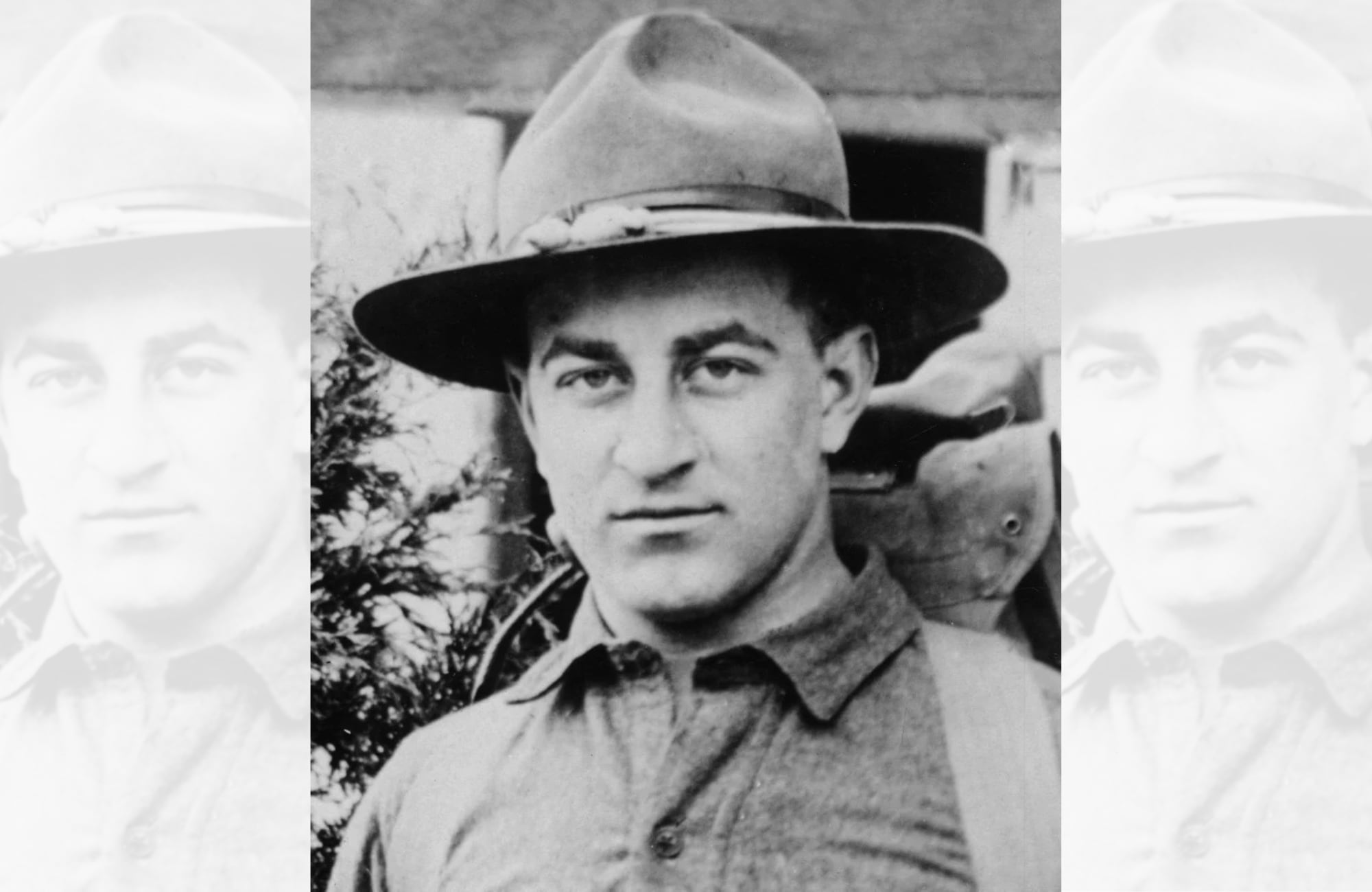
Born on Aug. 5, 1895, William Sawelson was a Jewish resident of Newark, New Jersey, when the United States declared war on Germany on April 6, 1917. He enlisted in Harrison, New Jersey, and after training he was assigned to Company M, 312th Infantry Regiment, 78th Division, serving as the company’s supply sergeant.
A Reserve unit made up of Jerseyans filled out with New Yorkers and Pennsylvanians, the 78th was initially dubbed the “President’s Own” because President Woodrow Wilson had been New Jersey’s governor, but the unit was later renamed the “Lightning Division” and adopted a red shoulder patch with a white lightning bolt as its insignia.
Landing in France in June 1918, the 78th Division initially lent its engineer units to support operations, in particular the 303rd Engineer Regiment. While it prepared for its turn at the front, the American Expeditionary Forces crushed the German Armee-Abteilung C around St. Mihiel between Sept. 12 and 18 with relative ease.
On Sept. 26, a reinforced AEF set off confidently to deal with Gen. Georg von der Marwitz’s V. Armee in the Meuse-Argonne sector — and ran into one brick wall after another.
In contrast to their defenses at St. Mihiel — caught in the midst of their retreat — the Germans in the Argonne had dug in behind three lines of fortifications. What followed was the largest and bloodiest campaign fought by the U.S. Armed Forces, as one division after another suffered high casualties until a newly arrived replacement took its place along the Western Front. It was in this crucible that Supply Sgt. Sawelson had his moment of truth.
In late October, the 78th phased its infantry units into the front lines to relieve the battered 77th Division. In so doing, it took up where its predecessor left off, advancing on the rail head and logistical hub at Grandpré. Thus far the AEF had conducted its agonizing advance in phases: from Sept. 26 to Oct. 4 and Oct. 4 to the 28th.
On Oct. 26, however, Sawelson and fellow 78th Division troops came into premature contact with the enemy, who were hardly about to follow the Americans’ agenda. Driven to ground under a hail of machine gun fire, they could do little until extra support came up. Sawelson’s actions were cited afterward:
“Hearing a wounded man in a shell hole, some distance away calling for water, Sgt. Sawelson, upon his own initiative, left shelter and crawled through heavy machine gun fire to where the man lay, giving him what water he had in his canteen. He then went back to his own shell hole, obtained more water and was returning to the wounded man when he was killed by a machine gun bullet.”
Sawelson’s sacrifice made an impression on the 78th. At a time when the AEF was reluctant to recognize the deeds of Jewish soldiers, Sawelson’s officers and comrades-in-arms were startlingly swift in recommending him for the highest American honor and on Jan. 22, 1919, his father, Jacob L. Sawelson, was awarded his posthumous Medal of Honor.
Buried at Meuse-Argonne American Cemetery and Memorial east of the village of Romagne-sous-Montfaucon, Sawelson was one of nine Americans slain in the battle for Grandpré.