
This story was originally published by The War Horse, a nonprofit newsroom covering the human experience and cost of military service. Get more reporting like this in your inbox.
Bernardino Mijares has spent most of his life searching for his father.
For many years, all the 33-year-old tricycle taxi driver knew was the name his mother had told him — which later was found to be incorrect — and that his father had served in the Philippines with the U.S. Navy. Growing up in the city of Antipolo, Mijares was often singled out because of his darker skin and curly hair. He came to understand that his father was Black, but looking different from other Filipinos exposed him to bullying at school and limited his opportunities later in life.
“Discrimination, it’s hard,” Mijares said. “I didn’t have recognition in school. I don’t have a family tree. I feel incomplete.”
Mijares is one of more than 100,000 Amerasians, a term commonly used for children born in Asian countries to U.S. service members and local women. Many grew up in the aftermath of American wars and military deployments in Korea, Vietnam, the Philippines, and elsewhere, often facing stigma, poverty, and exclusion. While U.S. forces over the years have been deployed worldwide, the scale of the Vietnam and Korean wars resulted in high numbers of children fathered by US servicemen in Asia. This, coupled with the perception of the U.S. as the enemy or an occupying force, contributed to heightened stigma for the children they left behind.
Now, as many of the American servicemen from those wars enter their twilight years, some Amerasian children are running out of time to find them.
Those who served in Vietnam and Korea, in particular, “are getting old,” said Chelle Reed, founder of the charity WarBabies, which works to reconnect U.S.-based Amerasians with their fathers. Her father was a Vietnam War veteran who she later learned had fathered a son during his deployment before she was born. Unfortunately, her father died before her brother was found.
Stories like these are why Mijares considers himself one of the lucky ones. After years of searching — and a decade spent talking with a man who turned out not to be his father — a DNA test finally gave him an answer.
Days before Father’s Day in June 2025, the nonprofit Father Founded confirmed that Clifford Jeudy, a 52-year-old radio DJ living in Orlando, Florida, was Mijares’ biological father.

Jeudy had no idea he had left a child behind during a three-week stint to the Filipino island of Luzon in 1992.
He was 18, fresh out of high school, and serving on his first Navy deployment aboard the USS Belleau Wood. The ship was stationed in Subic Bay as the United States prepared to end its permanent military presence in the Philippines.
Jeudy described his relationship with Mijares’ mother as a “whirlwind.” He said he was drawn to her resemblance to Holly Robinson, one of his favorite actresses at the time. But the relationship ended when the ship departed.
“We didn’t have the internet [or] cell phones,” Jeudy recalled. “We talked about her coming over, but it was such a whirlwind type of situation, and the next thing you know, I’m in my dress uniform on the ship and we’re leaving Subic Bay.”
Neither heard from the other again and so he had no idea that months after he left, she gave birth to a son.
Thirty-three years later, Jeudy was on his way home from work in Florida when his fiancée called to say she had signed for an important-looking envelope. He asked her to read it aloud. As he stared at the road ahead, hands gripping the steering wheel, he learned that he not only had a son, but three grandchildren.
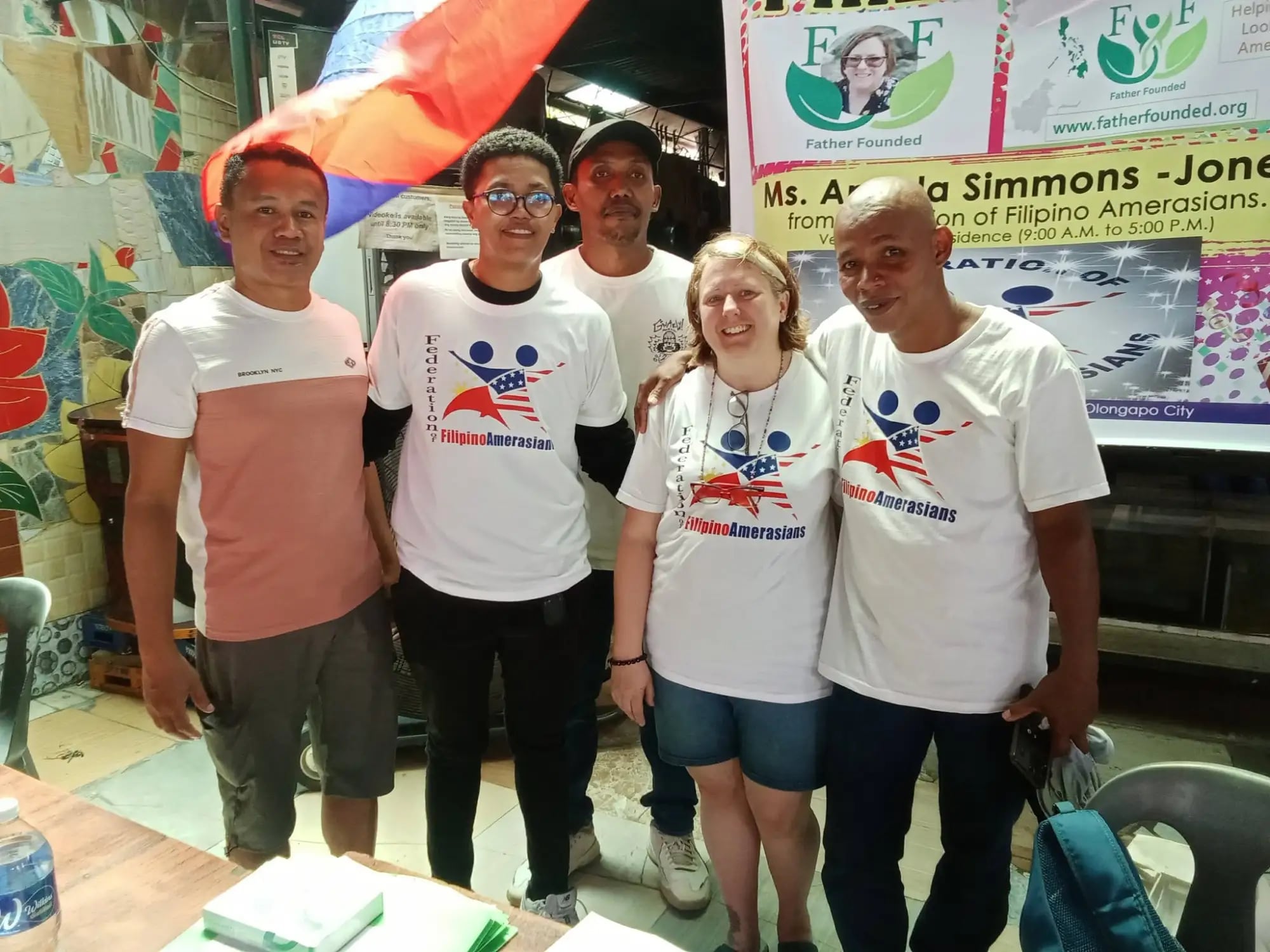
Father Founded, which has successfully identified family members in 452 cases, had used DNA to identify Jeudy and contacted him on Mijares’ behalf. The nonprofit also served as an intermediary between a father and son living on different continents and speaking different languages.
Jeudy was stunned.
“I went from having one biological son and two stepsons to having a whole bloodline,” said Jeudy, who had no other grandchildren. He did not need to study the DNA results. The enclosed photograph of Mijares was enough.
“The pictures when he was young … the similarity [is] amazing,” Jeudy said.
Jeudy’s other son and extended family welcomed Mijares, albeit only over video calls so far. Jeudy says he hopes to visit the Philippines soon.
The Cost of Being Amerasian
Mijares’ reunion with his father brought answers after decades of uncertainty. But his childhood reflected a broader pattern experienced by many Amerasian children born in the aftermath of U.S. wars and military deployments.
Brian Hjort, founder of Father Founded, said Amerasian children were often stigmatized because of their American parentage and mixed-race appearance in Vietnam. In some communities, he said, they were treated as reminders of “the enemy.”
“[They] are discriminated [against], not allowed to take certain jobs or education,” Hjort said. “They grow up being outcasts.”
Mijares’ mother left him in the care of his grandmother and went on to marry and have three other children. He had to navigate life as an Amerasian without any of his peers looking like him or knowing who his father might be.
“My mother could not take care of me back then because she had her own family, and her other children were her priority,” he said. “People would always ask where my father was, wonder why I had no middle name, or notice I stood alone during family days. … But I managed to get through all of that.”
With limited financial means, he was not able to go past the elementary level in school, narrowing his employment options and earning potential. He relied on friends and his grandmother to support him until he was old enough to work.
“I was only 12 years old at the time and I could not work to provide for myself,” Mijares said of his life after finishing elementary school. “I just went wherever I could, until I was no longer able to continue schooling.”
For Julie Henning, who grew up in South Korea after the Korean War, the consequences were even more severe.
Henning said she and her mother were shunned because she was the child of a Korean woman and an American serviceman. People saw them as bringing shame and dishonor to the community.
“[I was] considered a half-breed, less than a dog,” Henning said.
Her father had returned to the United States by the end of the war in 1953. At this time, South Korea had plunged into the worst levels of poverty globally, and Henning’s mother struggled to support her family. It didn’t help that societal stigma from having been involved with an American soldier blocked her from certain employment. Henning remembers growing up without running water and foraging for dandelions, mushrooms, and snails. Her sister died of malnutrition.
Henning said her mother considered putting her up for adoption multiple times, but could not go through with it.
When Henning was 13, she received a scholarship to attend the Pearl S. Buck Opportunity Center near Seoul, run by the Pearl S. Buck Foundation, which served children who faced discrimination because of their mixed heritage. Soon after Henning arrived in the South Korean capital, her mother died.
Henning has long believed that her mother saw her departure for school as a chance for her daughter to build a different life.
“[My mother] impressed upon me to get an education and go to America, the land of your father,” Henning said through tears.
The author Pearl S. Buck later adopted Henning and brought her to the United States, where she attended college and became a math teacher and author.
Mijares’ and Henning’s experiences were not unusual. The discrimination Amerasians faced was one reason Hjort started a group to help them.
In Vietnam, some Amerasian children were derided as “dust,” a reference to those left to survive on the streets. In South Korea, biracial children were sometimes labeled “mixed bloods,” while in Thailand they were called “half children.” Research has documented Amerasians struggling with poverty, limited educational opportunities, and lasting harm to employment, income, and mental health.
“I saw the Vietnamese really treat them badly … talk down to them and abuse them,” Hjort said, speaking of the time he spent in Vietnam in the 1990s and the impetus for creating Father Founded.
His work is made harder because many veterans themselves do not know they left children behind, but finding them has become easier than it was in the 1990s. Researchers once relied on military records to determine where servicemen had been stationed and when.
Today, DNA testing, ancestry databases, and social media can narrow the search. Even so, some cases take years. Once the organization identifies a likely father, it contacts him on the child’s behalf. Some men are overjoyed. Others are hesitant.
“Sometimes people don’t want to be reminded about the past,” Hjort said. “[These were] very bad wars and people have remarried and had their own kids.”
For the children, however, the past has never been distant. Many grew up facing discrimination because of their appearance and American parentage, without knowing the identity of the father who shaped how others saw them.
The Immigration Barrier
For some Amerasians, finding an American father is tied not only to identity, but also to hope of learning more about the United States and perhaps one day visiting.
The Amerasian Homecoming Act of 1987 allowed certain Vietnamese children of U.S. service members born between 1962 and 1976, and their immediate family, to immigrate to the United States without definitive proof of paternity. Applicants could qualify based on interviews, physical appearance, testimony, and other evidence. Prior to this, a broader act, the Amerasian Act of 1982, applied to those born in Korea, Vietnam, Laos, Cambodia, and Thailand after 1950 and before 1982, but only applied to the Amerasians themselves, not the family members.
The law ultimately allowed at least 25,000 Vietnamese Amerasians and 70,000 relatives to immigrate.
“Our country knew that our men over there did this and left so many children behind,” said Reed. “They didn’t have DNA testing back then … but the government wanted to do the right thing.”
WarBabies’ Reed said the law allowed her Amerasian brother to leave Vietnam in 1990 even though he had not yet identified their shared father. Reed has a different mother from her brother and was born after her father returned to the U.S. Years after finding one another, brother and sister now live in Georgia, about 15 minutes away from one another.

For Amerasians born elsewhere in Southeast Asia, including Thailand, Cambodia and the Philippines, no comparable program exists. Without documented proof of paternity in the form of a birth certificate or a recognized claim to U.S. citizenship, immigration can be difficult.
“They want to have the love of their father and to be accepted,” Hjort said. “Of course, they hope to go to America, but they realize … it’s not easy.”
For Mijares, however, the search was never about moving to the United States. He wanted to know who his father was, understand his American heritage, and fill a gap that shaped his life.
Mijares now speaks regularly with his younger brother and has connected with members of Jeudy’s extended family. Jeudy hopes to meet his son and grandchildren in person in the near future.
Jeudy said he believes children who can prove a biological relationship to an American parent should have a clearer path to recognition, and, where legally justified, United States citizenship. The State Department offers support if a person can prove their father’s U.S. citizenship and has their name on their birth certificate. The challenge is when an individual lacks that vital paperwork or doesn’t know who their father is. Even in cases where they have identified them and there is DNA available, it would need to be backed up with an affidavit from the father in place of a birth certificate, but even then citizenship is at the discretion of the embassy or consulate in question.
“If we could prove that these are our children … they should have the option to get their names changed and potentially citizenship,” Jeudy said.

Time is Running Out
As Vietnam veterans in particular enter their final years, Amerasian families are running out of time to find them.
“A lot of them have Agent Orange exposure, and they’re very ill,” said Reed. She said her organization has helped reunite 102 families.
The time factor applies to veterans from other missions too. By the time math teacher and author Julie Henning found her father’s relatives in South Carolina, he had been dead for four years. She later visited his grave, the only connection still available to her.
“This is the man I never knew, but this is the man who gave me life,” Henning said. “It was [a] really strange unreal feeling. … You cannot quite put it in words.”
She also learned that she had a brother, but he too passed away, months after she spoke to him for the first time.
Reunions are not always simple.
Families may face language barriers, cultural differences, conflicting expectations, and resentment over decades of absence.
People have ideas that their mystical father will be “sitting on a white horse,” Hjort said, then they realize he’s more likely to be “an old chap with a beer gut.”
Some fathers have also spent decades searching for children they left behind.
Jim Reischl served one tour in Vietnam when he was 21 and had a girlfriend, whom he rented a room for near his base. After a few months of dating and just before he was set to head home, she told Reischl she was pregnant. He didn’t want to stay in the country longer than necessary, and he’d been warned in orientation upon arrival in Vietnam that this was a common line used to try to secure passage to America. Skeptical, Reischl left Vietnam but wrote her letters, hoping to learn more about whether the child existed. He never heard back.

In 2005, the question mark over whether he had a child in Vietnam loomed too large, so he reached out to Hjort’s team for help locating the woman and her potential child. He found her after placing an ad in a local newspaper in 2015, and he traveled to Vietnam the following year to visit in person. Reischl’s former girlfriend said that after giving birth, she gave the baby to a local woman to put up for adoption after her family warned of the difficulties of raising a biracial baby. But with few details, he’s still unsure whether he has a child out there or who they might be.
Robert Elliot left a military base near Da Nang, Vietnam, in 1971, knowing the woman he had been seeing was eight months pregnant. He felt that staying wasn’t a realistic option at the time, but planned to maintain contact and figure out a solution. That didn’t happen.
Now, 55 years after leaving Vietnam, Elliot still does not know what became of the child.
“I’ve been searching for close to 30 years, but I haven’t received any hits on DNA,” Elliot said.
Reed said such unresolved cases are common. Her organization has 29 open searches, and many Amerasian families continue looking without knowing whether the veteran they seek is still alive.
“They don’t want to … disrupt their [fathers’] lives,” Reed said. “But they have a deep, internal knowing that they need to know who they are—just a picture or a name. Even to be able to give that to them would satisfy them.”
She urges veterans who believe they have fathered children overseas or their family members to submit DNA to ancestry databases that can then help to identify family members and ancestral ties. Even when Amerasians do not find their fathers in time, DNA testing can connect them with siblings, cousins, or other relatives.
“I don’t care if they think or deny that they had a possibility of children,” Reed said. “They should get tested now.”
For some veterans, testing can create a reunion — or help some other family resolve their case. But for others, a match may only lead to a grave, a photograph, or the name of someone who died before they could be found.
But with each passing year, even those answers become harder to reach.
This article from The War Horse was edited by Paul Szoldra, fact-checked by Jess Rohan, and copy-edited by Mitchell Hansen-Dewar.


