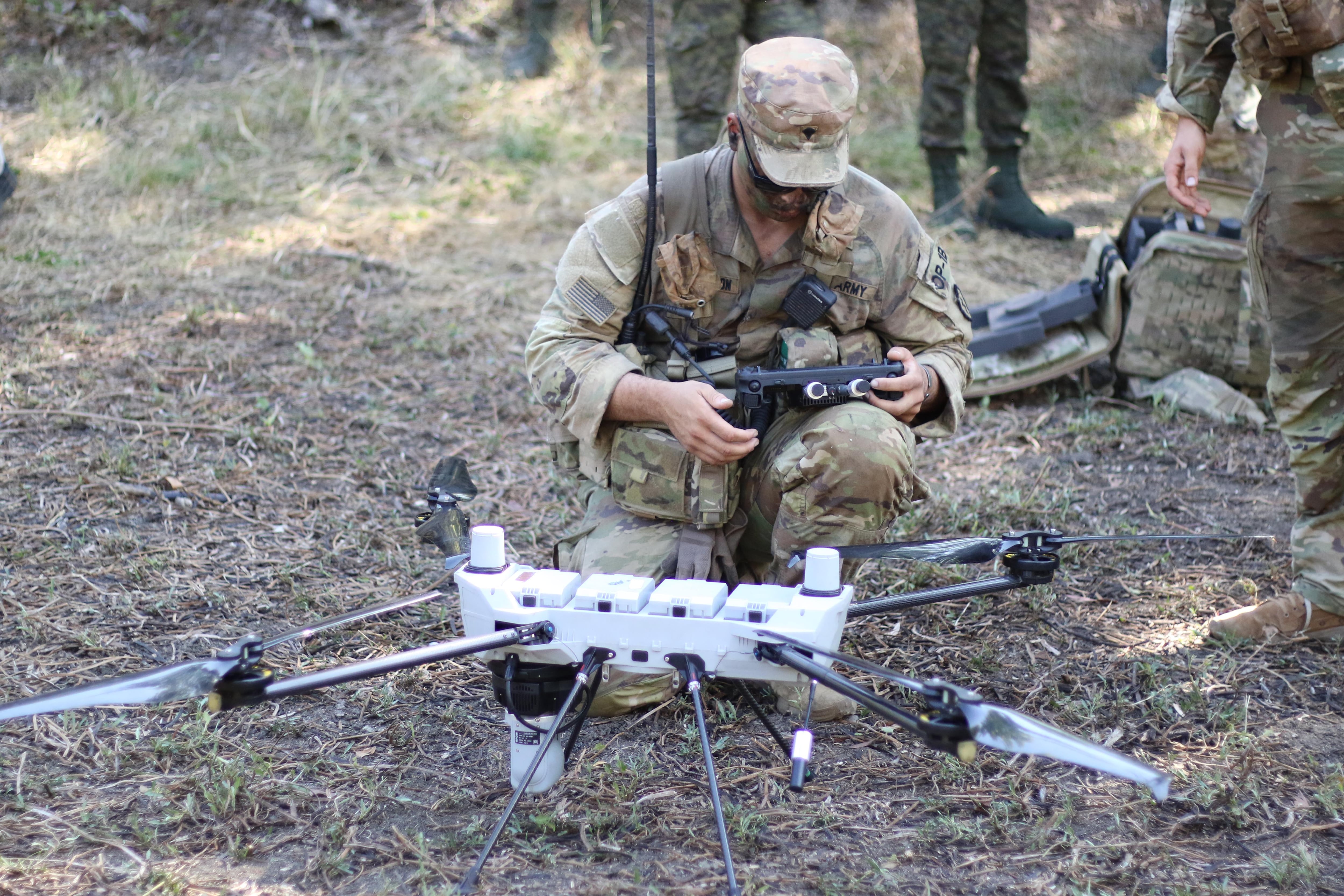
FORT MAGSAYAY, Philippines — As an American reconnaissance drone hummed overhead, soldiers of the U.S. and Philippine armies stormed forward through the jungle terrain, laying down suppressive fire on enemy positions.
Finishing off the foe’s stubborn resistance, a Kestrel first-person-view (FPV) drone carrying an explosive payload slammed into the enemy bunker. Afterwards, sweating profusely in the 97ºF heat, the Americans and Filipinos secured the area.
This jungle patrol in the thickly vegetated training area of Fort Magsaysay, located 75 miles north of Manila, was just one of many events taking place across the Philippines in Exercise Balikatan 2026.
More than 17,000 troops from seven countries are participating in this multilateral exercise being held from Apr. 20 to May 8.
The major U.S. Army contingent in Balikatan is the 3rd Mobile Brigade of the Hawaii-based 25th Infantry Division. The soldiers conducting this realistic drill were from Alpha Company, 2nd Battalion, 27th Infantry Regiment, alongside troops from the Philippine Army’s 1st Brigade Combat Team.
This engagement integrating new tech underscored how the “Tropic Lightning” division is transforming and adopting new technologies as one of the Army’s two original Transformation in Contact divisions. It is required to do so by the changing nature of modern warfare.
Col. Adisa King, the 3rd Mobile Brigade commander, told Defense News that technology does help: “It reduces risk a little bit, but it allows you to see farther.”
“The challenge is how do you mass that? What if I had ten of those [drones]?” King asked. “They go up to disrupt or they go up to help me see, and we push them all the way down to lower levels. But sustainment is the issue.”

Indeed, the technology can be fickle, King pointed out: Drones can overheat in the tropical climate, soldiers have to lug extra equipment around, jungles are often too thick for FPVs, and recharging batteries is another challenge.
Yet King listed three things his brigade gains from participating in Balikatan: becoming familiar with an environment the soldiers might one day fight in; learning from partners; and rehearsing how to fight together.
Underscoring their modernization push, these Hawaii-based soldiers were carrying the latest M7 assault rifles, and new M1301 Infantry Squad Vehicles (ISV) provided them rapid maneuverability.
Lightning Lab innovation
Elsewhere, Lightning Labs illustrates how the 25th Infantry Division is prioritizing innovation and iteration. This cell was designed to accelerate the adoption of new technologies.
The Kestrel “killer” FPV quadcopter, measuring five inches across and capable of swarming, is one such fruit. CW3 Aaron Dunson, Operations Officer of Lightning Labs, said the Kestrel is designed for mass production. The aim is to get them into the hands of soldiers so they can identify their capabilities and limitations.
Lightning Labs is also developing a high-speed drone interceptor. In addition, the lab was testing a containerized solar-panel micro grid to generate electricity, a quieter alternative to diesel generators. Dunson described it as “a very viable solution” in the Philippines.
He shared that his cell is covering capability gaps while industry races to catch up. “Our piece of this pie is to identify the opportunity and then present it to the subject matter experts within the division and say, ‘Is this usable?’”
Forge ahead
Another innovation appeared last year – the Forge – an INDOPACOM initiative where a dozen Army and Marine personnel run an expeditionary manufacturing capability based at Schofield Barracks, Hawaii. It is armed with deployable equipment like industrial-grade 3D printers (polymer and metal), milling machines and 3D scanners.
The Forge comes up with rapid solutions. During Balikatan, for example, a road grader from an engineering unit was disabled due to broken bolts. Instead of waiting ten weeks for spares to arrive from the U.S., the Forge reverse-engineered and manufactured them in six hours.
Likewise, soldiers complained of broken bipods on their new M50 machine guns, so the unit came up with a 3D-printed solution to fix that too.
The Forge’s services have been in demand throughout Balikatan. It had 36 projects on the go, with twelve completed by halfway through the exercise. One of them was producing 300 Kestrel drone frames.
The Forge saves soldiers time and money. CW2 Kevin Ton, officer in charge of the Forge, said it had saved $23,000 and a cumulative 96 months in waiting time for spare parts in the first week of Balikatan alone.
With multiple security challenges in Asia-Pacific – high among them being Chinese belligerence – there is a need for the Army to adapt quickly and to speedily field the latest technologies.
The 25th Infantry Division epitomizes this rapid change that United States Army Pacific is undergoing. Another example is that it is the Army’s only infantry division to possess HIMARS rocket launchers.
Gordon Arthur is an Asia correspondent for Defense News. After a 20-year stint working in Hong Kong, he now resides in New Zealand. He has attended military exercises and defense exhibitions in about 20 countries around the Asia-Pacific region.


