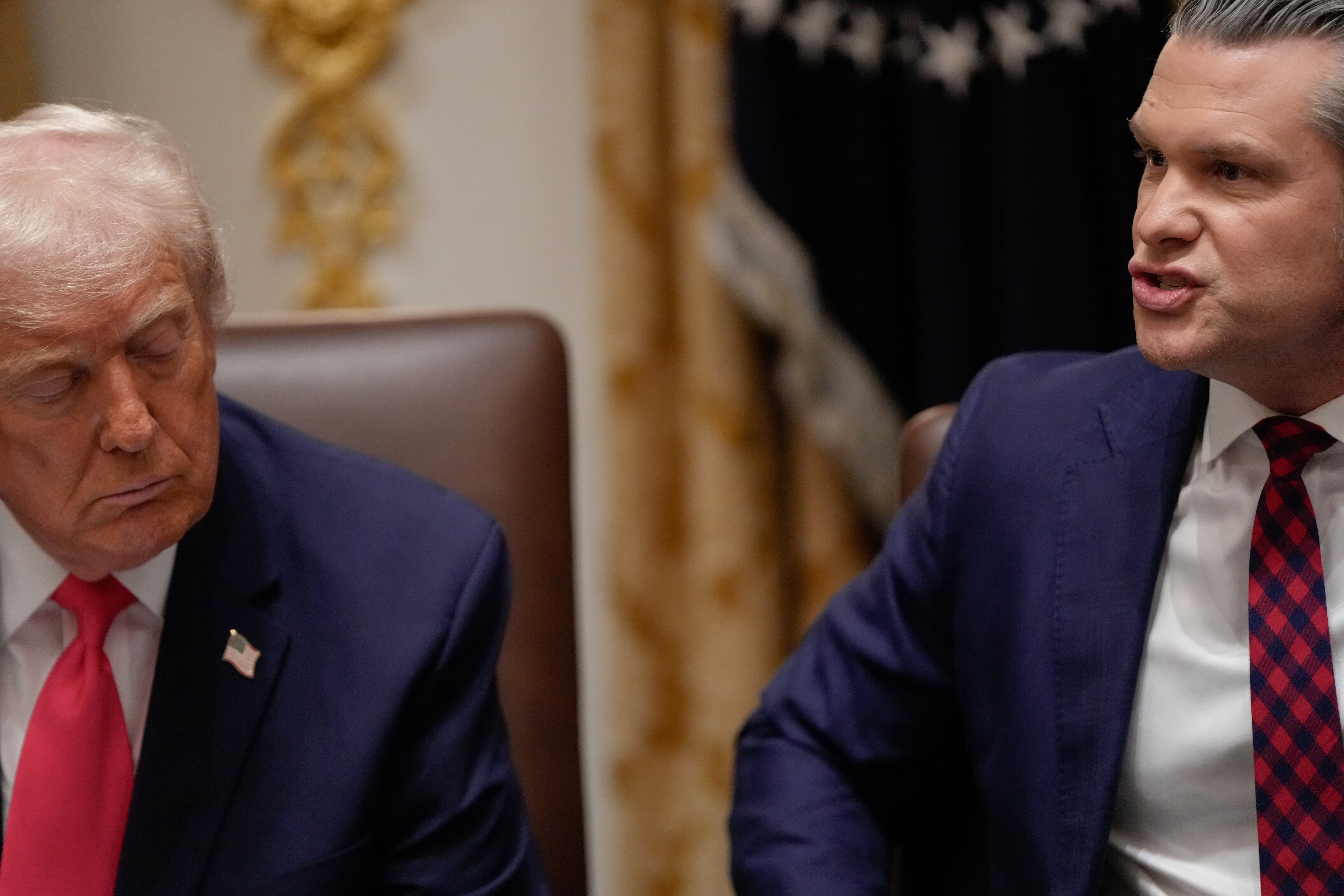
Defense Secretary Pete Hegseth told reporters at a White House Cabinet meeting Tuesday he was unaware a September U.S. military strike against an alleged drug-carrying vessel in the Caribbean left survivors, who were killed in a subsequent strike.
The statement came several days after a Washington Post story said Hegseth had reportedly ordered Adm. Frank M. “Mitch” Bradley and the SEAL Team 6 he oversaw to kill everybody aboard the vessel and leave no survivors. The report said that an initial strike against the vessel on Sept. 2 left two survivors clinging to their vessel’s wreckage, but that a second strike ordered afterward killed them.
Former JAGs and senior lawmakers have said such actions would constitute war crimes, if the report is true.
“I did not personally see survivors,” Hegseth said. “The thing was on fire, it was exploded, in fire, in smoke, you can’t see anything, you got digital — this is called the fog of war. This is what you in the press don’t understand. You sit in your air-conditioned offices or up on Capitol Hill and you nitpick and you plant fake stories.”
During a Sept. 3 Fox News interview, Hegseth said he had watched the Sept. 2 strike live. It was the first strike against alleged drug-carrying vessels in the Caribbean and eastern Pacific Ocean that the Trump administration has said are part of counternarcotics efforts.
But speaking to reporters at the White House Cabinet meeting Tuesday, Hegseth said he had watched the first strike live and then left for his next meeting.
It was only a couple of hours later, Hegseth said, that he learned Bradley had made “the correct decision” to sink the boat and eliminate the threat.
Since The Washington Post broke its story, the White House and defense secretary have repeatedly used language placing the onus of responsibility for the follow-up strike on Bradley.
White House press secretary Karoline Leavitt said Monday that Bradley had ordered the second strike and had acted “within his authority and the law” when he did so.
“Admiral Mitch Bradley is an American hero, a true professional, and has my 100% support. I stand by him and the combat decisions he has made — on the September 2 mission and all others since,” Hegseth wrote on X.
The New York Times published a conflicting report that said Hegseth ordered a strike but not the killing of survivors.
Specifically, the New York Times report said five officials the newspaper spoke with said Hegseth did not detail what should happen in the event of survivors and that the order he gave was not in response to any surveillance footage depicting survivors.
President Donald Trump told reporters aboard Air Force One on Sunday that he did not know about the second strike, but would not have wanted one.
When asked again during the Cabinet meeting about the second strike, Trump said neither he nor Hegseth knew about the second strike.
“As far as the attack is concerned, I didn’t, you know, I still haven’t gotten a lot of information because I rely on Pete,” Trump told reporters.
“They had a strike, I hear the gentleman that was in charge of that is extraordinary, extraordinary person — I’ll let Pete speak about him — but Pete was satisfied. Pete didn’t know about a second attack having to do with two people,” he said.
Riley Ceder is a reporter at Military Times, where he covers breaking news, criminal justice, investigations, and cyber. He previously worked as an investigative practicum student at The Washington Post, where he contributed to the Abused by the Badge investigation.