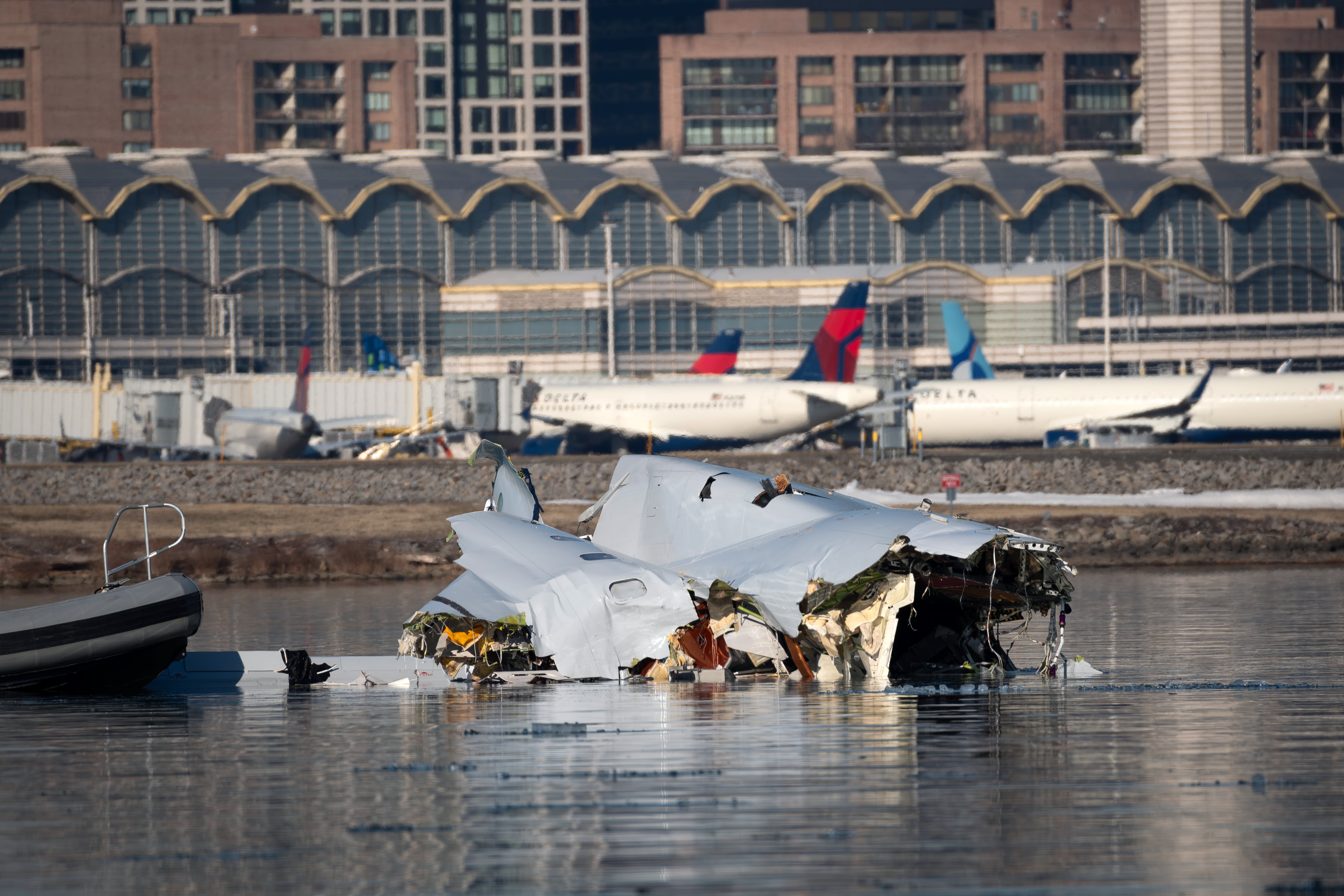
The National Transportation Safety Board said “systemic failures” by multiple agencies, including the U.S. Army, led to the mid-air collision last year between an Army UH-60 Blackhawk and an American Airlines regional jet over the Potomac River in Washington, D.C.
Following a year-long investigation into the Jan. 29, 2025, crash, the NTSB said Tuesday that the main cause of the accident was the longstanding use of a helicopter route in the path of a runway approach and failures by the Federal Aviation Administration to act on recommendations to mitigate risk at Ronald Reagan Washington National Airport.
They cited numerous issues that led to the collision, including an overtasked air traffic control system, busy helicopter flight paths and the FAA’s failure to analyze and address hundreds of close calls in the region in the past decade.
The investigation also found that the Army failed to educate its pilots on a known problem with the helicopter’s barometric altimeters that likely caused the Blackhawk crew to think they were flying 100 feet lower than they were.
The NTSB also said the air traffic controllers at the facility frequently relied on pilots seeing one another — “visual separation” — to avoid collisions and the Blackhawk crew likely did not see the aircraft that it struck.
“This helicopter route shouldn’t have been there in the first place,” NTSB Chairwoman Jennifer Homendy said during the hearing Tuesday. “I also felt it was critical … to talk about the error tolerances of barometric altimeters and the lack of pilot knowledge of knowing that they thought they were at 200 feet and they were actually at 300 and above at some points, which is unacceptable.”
A simulation shown at the hearing from the perspective of the Army crew showed the pilots, using night-vision goggles, had limited visibility and likely thought the jet was one of several lined up farther away to land on the airport’s main runway.
The aircraft, American Airlines Flight 5532, was routed to a lesser-used diagonal runway that crosses the helicopter route and is used for roughly 7% of landings at the airport.
Air traffic control advised the Army aircraft to go behind the American Airlines aircraft but did not include specific information on the aircraft’s location. The radio transmission to the helicopter was garbled and the pilots did not hear the instruction to go behind the plane. They responded that they saw the aircraft, but according to the simulation, they likely weren’t looking at the correct jet.
In cockpit communication, the Army crew appeared to be concerned about their location because they were above the middle of the river; the helicopter route hugs the shoreline. They were moving to the left when the collision occurred, according to the NTSB.
The accident killed 67 people — 64 aboard American Airlines Flight 5342 from Wichita, Kansas, and three aboard the Blackhawk helicopter.
The soldiers killed were the pilot, Capt. Rebecca Lobach, pilot instructor Chief Warrant Officer 2 Andrew Eaves and crew member Staff Sgt. Ryan O’Hara.
The jet passengers included several members of an ice skating club, their parents and instructors, including the parents of Maxim Naumov, a member of the 2026 U.S. Olympic skating team.
At the time of the accident, the Blackhawk was flying along a helicopter path known as Route 4 returning to Fort Belvoir, Virginia, after a night of training exercises. In 2013, as a result of several close calls between helicopters and fixed-wing aircraft in the Washington, D.C., region, a body known as the Tower Helicopter Working Group recommended the route be altered or abandoned.
But that recommendation, as well as another calling the FAA to highlight particularly dangerous areas in the airspace on regional maps and navigation systems, were not implemented.
Immediately following the mid-air collision, the NTSB issued an emergency recommendation that the route be closed when the airport is using its smaller runways. The FAA moved to permanently restrict helicopters from flying the route.
In the hearing Tuesday, the NTSB proposed 48 additional recommendations, including 32 for the FAA, eight for the Army, five for the Department of Defense and the remainder to other federal agencies.
The panel found that while the Army has an occupational hazard reporting program and an Army Safety Management Information System, these programs depend on voluntary reporting by pilots or they do not provide adequate information on mishaps or near misses near Reagan National to educate those who operate in the airspace.
The Army is creating a new safety and occupational health management system to be implemented by 2030, but the NTSB found the program has been delayed by resource and staffing issues.
The board urged the Army to address its safety and training shortcomings.
“We found the Army lacked a positive safety culture in that its aviation safety system does not have the capacity, resources or analytical mechanisms to consistently detect, interpret and act on weak signals of latent hazards,” said staff members working on the investigation.
The NTSB recommended that the service: revise its training procedures for flight crews assigned to Washington; develop and implement recurring procedures to verify flight data accuracy; ensure that crews are knowledgeable about the errors that can occur with barometric altimeters; develop and implement transponder inspection procedures and allocate resources for a “robust safety management system.”
It recommended that the Department of Defense evaluate and implement any needed enhancements for radio communications in all aircraft and update aircraft to ensure that they are capable of monitoring civilian air traffic, among other suggestions.
The board’s final report will be released in the coming weeks.
At the start of the hearing, Homendy cited other mid-air collisions she has studied, saying that the similarities between those that occurred roughly 50 years ago were “chilling.”
“We should be angry, because for years, no one listened,” Homendy said. “This was 100% preventable.”
Patricia Kime is a senior writer covering military and veterans health care, medicine and personnel issues.