WASHINGTON – There are few sacred cows left in the world of Army acquisition, as the service showed earlier this year in slashing the Ground Combat Vehicle from its list of development programs, even after chief of staff Gen. Ray Odierno repeatedly extolled the platform as a must-have capability to replace the Bradley Fighting Vehicle.
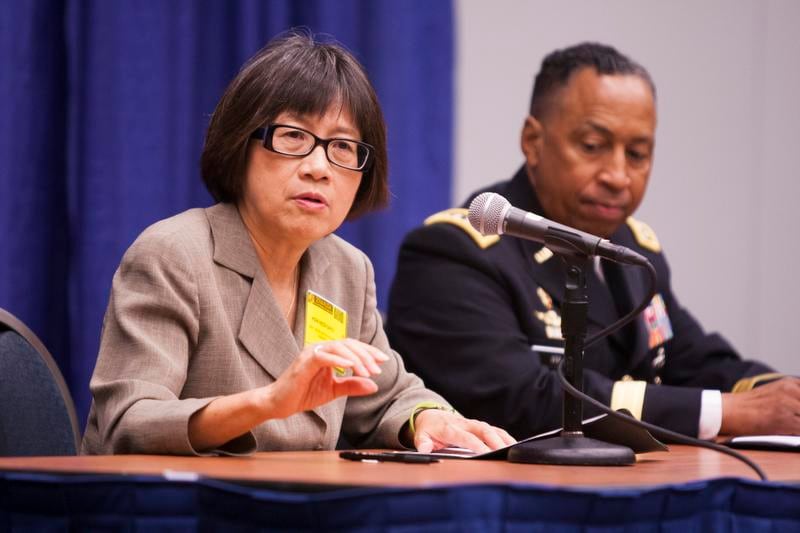
Even the Joint Light Tactical Vehicle (JLTV), which has had a pretty smooth path as of late, isn't necessarily safe in the current budget environment. While the vehicle is "not currently being targeted ... we don't know how bad our cuts are going to be," Heidi Shyu, assistant secretary of the Army for acquisition, logistics, and technology, said Oct. 14. "At this point, in the president's budget, it looks fine. But beyond that, I can't tell you. I can't guarantee anything because I have no idea what our budget's going to be."
Under the new normal of continuing resolutions, budget fights between the White House and Congress and now the upcoming congressional elections, which could change the makeup of Capitol Hill, "you don't know where you're being slashed until the last minute, because we don't know what our budget is going to be," she said.
Ironically, the use of continuing resolutions to fund the government has actually has some positive effects on the Pentagon, since it slows the building to spend at last year's levels, which were given a reprieve from the sequester.
Shyu jokingly said that the continuing resolution "would be great because I could spend what I was authorized last year, right? As opposed to this year, because inevitably my budget is going to be cut."
While starting new programs is difficult, "we've got to continue to invest in modernization," said Army Materiel Command chief Gen. Dennis Via, who spoke on a panel with Shyu.
The Army spends about $2.4 billion annually on science and technology efforts, and Secretary of Defense Chuck Hagel has kicked off a program that would seek to protect that money while sharing some prototyping and research and development activities with close allies.
Continued research and development, even if not directed at a specific program in the pipeline, will still have positive effects for the service overall, Via said.
"The next platform that we require, the next piece of equipment that we issue to our soldiers, everything from the uniforms they wear to the weapons that they utilize to the platforms they fly in, we have to have it in place," he added.
If the US armed forces don't continue to invest in science and technology research in order to push capabilities forward, the ability of US forces to overwhelm competitors will dissipate, Via said. Without targeted investments, "that technical overmatch and that edge that we have today, over time, will narrow with the proliferation of technology throughout the world."
And if sequestration comes back in fiscal 2016 as it is slated to do, modernization programs would have to be stretched out, and the quantities of vehicles and helicopters the Army buys would shrink, making their overall costs go up, Shyu said. ■
Email: pmcleary@defensenews.com.